
No reviews yet. Be the first to share your experience!
Spironolactone Cream Compounded
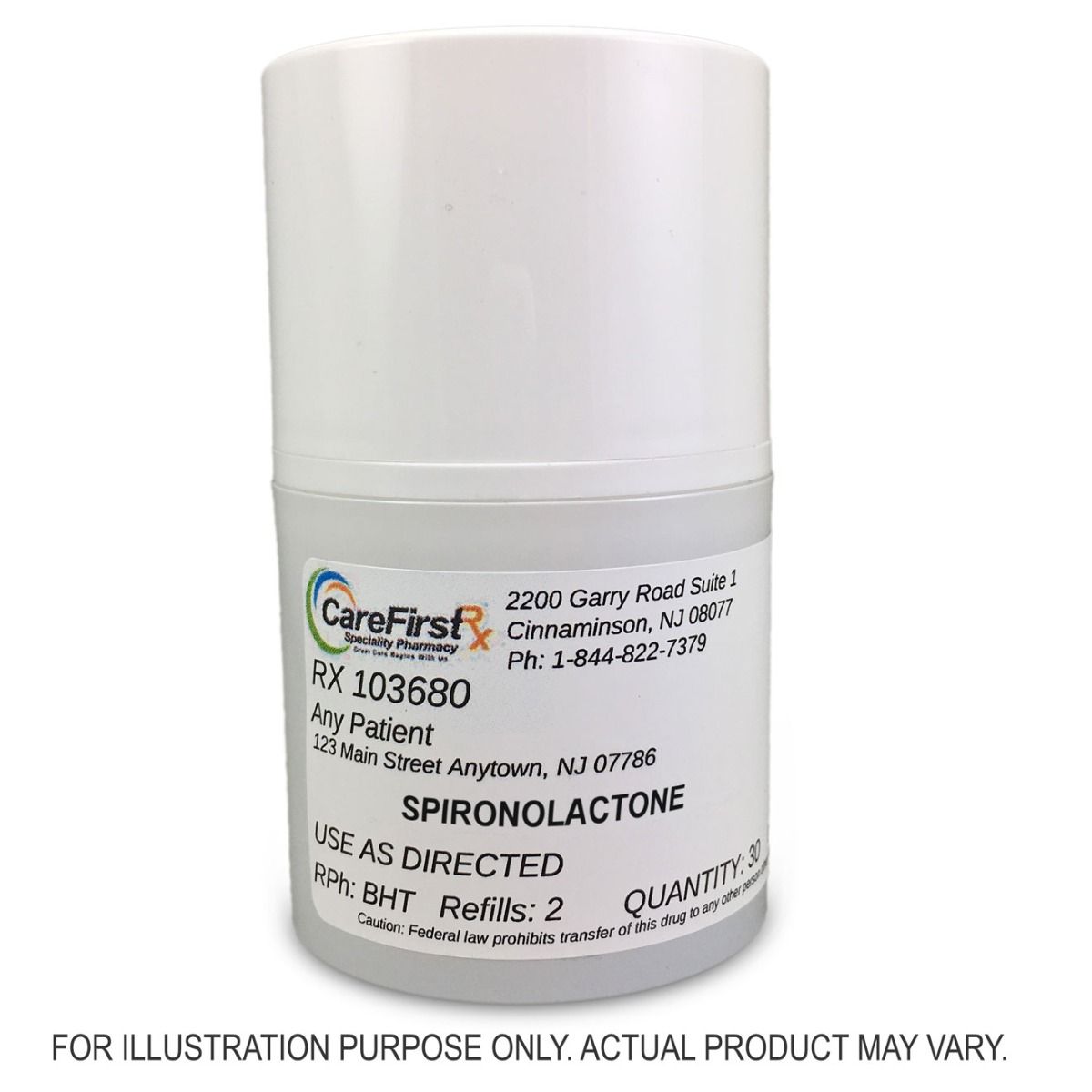
Spironolactone is a potassium-sparing diuretic and a competitive antagonist of the mineralocorticoid (aldosterone) receptor. You may buy Spironolactone from CareFirst Specialty Pharmacy with a valid prescription from your prescriber.
Start by selecting a form for your price
StrengthSelect a form first
QuantitySelect a strength first
Price: as low as $54.95
Please Note: Due to market volatility, prices are subject to change. Please contact us for the most current pricing.
Ready to Move Forward?
Select the action that best fits how you'd like us to handle the prescription.
This medication requires a prescription.
To process your order we will require a prescription from you or your Prescriber. We will only compound and dispense upon receipt of a valid patient specific prescription.
- Your prescriber can mail or fax in the prescription
- You can mail in the original prescription
- We can contact your prescriber for you
- You can transfer your prescription from another pharmacy

Are you a licensed Prescriber?
Choose the option that best fits how you’d like to send scripts or connect with us.
Fax Your Prescription
Fax (800) 786-1405 or (844) 922-7379 and we’ll process it right away.
Phone In
Call our pharmacists at (844) 822-7379 with prescription details.
Request More Info
Complete the prescriber form and we’ll follow up quickly.
Email Our Team
[email protected] for questions, refills, or status updates.

Looking for a Different Strength?
Pharmacy Info
We are a nationally accredited PCAB compounding pharmacy and a .Pharmacy verified website. A verified .Pharmacy website designation ensures our patients and prescribing partners that our website is verified and safe.
https://safe.pharmacy/buy-safely/?url=cfspharmacy.pharmacy
Drug Description
Actual product image may vary.
Product Info
Spironolactone is a potassium-sparing diuretic and a competitive antagonist of the mineralocorticoid (aldosterone) receptor.
Formulations
- Aldactone 25 mg Tablet: Each film-coated tablet contains 25 mg spironolactone.
- Aldactone 50 mg Tablet: Each film-coated tablet contains 50 mg spironolactone.
- Aldactone 100 mg Tablet: Each film-coated tablet contains 100 mg spironolactone.
Pronunciation: spy-ROH-noh-LAK-tone
Drug Class: Potassium-Sparing Diuretic and Aldosterone (Mineralocorticoid) Receptor Antagonist
Mechanism of action
Spironolactone is a selective aldosterone antagonist that competitively binds to mineralocorticoid receptors at the sodium-potassium exchange site in the distal convoluted renal tubule, increasing the excretion of sodium and water while conserving potassium. Through this mechanism, it acts as both a diuretic and an antihypertensive agent and can be used alone or with other diuretics that act earlier in the renal tubule.
Drug Interactions
Consider therapy modification with the following medications: potassium-increasing agents (risk of severe hyperkalemia), other diuretics or antihypertensive agents (additive effects), norepinephrine during anesthesia (reduced vascular responsiveness), digoxin (increased half-life and possible assay interference), nonsteroidal anti-inflammatory drugs such as aspirin, indomethacin, and mefenamic acid (reduced diuretic efficacy), antipyrine (increased metabolism), ammonium chloride or cholestyramine (risk of hyperkalemic metabolic acidosis), carbenoxolone (reduced efficacy of either agent), and abiraterone (possible increase in prostate-specific antigen levels due to androgen receptor binding).
Adverse events
Common side effects you might experience with spironolactone include: dizziness, headache, stomach upset or nausea, diarrhea, breast tenderness or enlargement, irregular menstrual periods, increased urination, and feeling tired or weak.
Administration
- Tablet: Administer with or without food; however, administer consistently with respect to food.
- Suspension: Shake well before administering dose. Administer with or without food; however, administer consistently with respect to food.
Dosing: Contact your healthcare provider for specific dosing instructions.
Pregnancy
Spironolactone can cross the placenta and may affect fetal hormone development. It is best to speak with your healthcare provider to determine whether the benefits outweigh the potential risks of using spironolactone during pregnancy.
Breastfeeding
Spironolactone and its active metabolites may be present in breast milk. The decision to breastfeed while taking spironolactone should consider the potential risk of infant exposure, the benefits of breastfeeding to the infant, and the benefits of treatment to the mother. Based on limited information, spironolactone is generally considered relatively compatible with breastfeeding.
Children/Pediatrics
For children 1 month of age or older, spironolactone is generally considered safe to use; however, dosing may vary depending on the child's age, weight, and clinical condition.
References
- Spironolactone [Lexi-Drugs]. Lexi-Comp. Wolters Kluwer Health, Inc. http://online.lexi.com. Accessed March 10, 2026.
- Spironolactone. Prescribing Information. Pfizer Inc. Revised June 2018. Accessed March 10, 2026.
- Buck ML. Clinical experience with spironolactone in pediatrics. Ann Pharmacother. 2005 May;39(5):823-8. doi: 10.1345/aph.1E618. Epub 2005 Apr 5. PMID: 15811903.
Active Ingredients
Spironolactone
Directions
Consult your prescriber.
Instructions
Use the medication as prescribed by your doctor. The information provided is not intended to cover all possible uses. This information is generalized and not intended as specific medical advice. If you have questions about the use of your prescription, please contact your prescriber.
Shipping
Troches and suppositories require refrigeration (ice packs) and will incur an extra charge of $19.95 per order.
Reviews
Customer Reviews
No reviews yet
Leave a Review
We are a nationally accredited PCAB compounding pharmacy and a .Pharmacy verified website. A verified .Pharmacy website designation ensures our patients and prescribing partners that our website is verified and safe.
https://safe.pharmacy/buy-safely/?url=cfspharmacy.pharmacy
Actual product image may vary.
Spironolactone is a potassium-sparing diuretic and a competitive antagonist of the mineralocorticoid (aldosterone) receptor.
Formulations
- Aldactone 25 mg Tablet: Each film-coated tablet contains 25 mg spironolactone.
- Aldactone 50 mg Tablet: Each film-coated tablet contains 50 mg spironolactone.
- Aldactone 100 mg Tablet: Each film-coated tablet contains 100 mg spironolactone.
Pronunciation: spy-ROH-noh-LAK-tone
Drug Class: Potassium-Sparing Diuretic and Aldosterone (Mineralocorticoid) Receptor Antagonist
Mechanism of action
Spironolactone is a selective aldosterone antagonist that competitively binds to mineralocorticoid receptors at the sodium-potassium exchange site in the distal convoluted renal tubule, increasing the excretion of sodium and water while conserving potassium. Through this mechanism, it acts as both a diuretic and an antihypertensive agent and can be used alone or with other diuretics that act earlier in the renal tubule.
Drug Interactions
Consider therapy modification with the following medications: potassium-increasing agents (risk of severe hyperkalemia), other diuretics or antihypertensive agents (additive effects), norepinephrine during anesthesia (reduced vascular responsiveness), digoxin (increased half-life and possible assay interference), nonsteroidal anti-inflammatory drugs such as aspirin, indomethacin, and mefenamic acid (reduced diuretic efficacy), antipyrine (increased metabolism), ammonium chloride or cholestyramine (risk of hyperkalemic metabolic acidosis), carbenoxolone (reduced efficacy of either agent), and abiraterone (possible increase in prostate-specific antigen levels due to androgen receptor binding).
Adverse events
Common side effects you might experience with spironolactone include: dizziness, headache, stomach upset or nausea, diarrhea, breast tenderness or enlargement, irregular menstrual periods, increased urination, and feeling tired or weak.
Administration
- Tablet: Administer with or without food; however, administer consistently with respect to food.
- Suspension: Shake well before administering dose. Administer with or without food; however, administer consistently with respect to food.
Dosing: Contact your healthcare provider for specific dosing instructions.
Pregnancy
Spironolactone can cross the placenta and may affect fetal hormone development. It is best to speak with your healthcare provider to determine whether the benefits outweigh the potential risks of using spironolactone during pregnancy.
Breastfeeding
Spironolactone and its active metabolites may be present in breast milk. The decision to breastfeed while taking spironolactone should consider the potential risk of infant exposure, the benefits of breastfeeding to the infant, and the benefits of treatment to the mother. Based on limited information, spironolactone is generally considered relatively compatible with breastfeeding.
Children/Pediatrics
For children 1 month of age or older, spironolactone is generally considered safe to use; however, dosing may vary depending on the child's age, weight, and clinical condition.
References
- Spironolactone [Lexi-Drugs]. Lexi-Comp. Wolters Kluwer Health, Inc. http://online.lexi.com. Accessed March 10, 2026.
- Spironolactone. Prescribing Information. Pfizer Inc. Revised June 2018. Accessed March 10, 2026.
- Buck ML. Clinical experience with spironolactone in pediatrics. Ann Pharmacother. 2005 May;39(5):823-8. doi: 10.1345/aph.1E618. Epub 2005 Apr 5. PMID: 15811903.
Spironolactone
Consult your prescriber.
Use the medication as prescribed by your doctor. The information provided is not intended to cover all possible uses. This information is generalized and not intended as specific medical advice. If you have questions about the use of your prescription, please contact your prescriber.
Troches and suppositories require refrigeration (ice packs) and will incur an extra charge of $19.95 per order.
Customer Reviews
No reviews yet