
No reviews yet. Be the first to share your experience!
Hydroxychloroquine Compounded
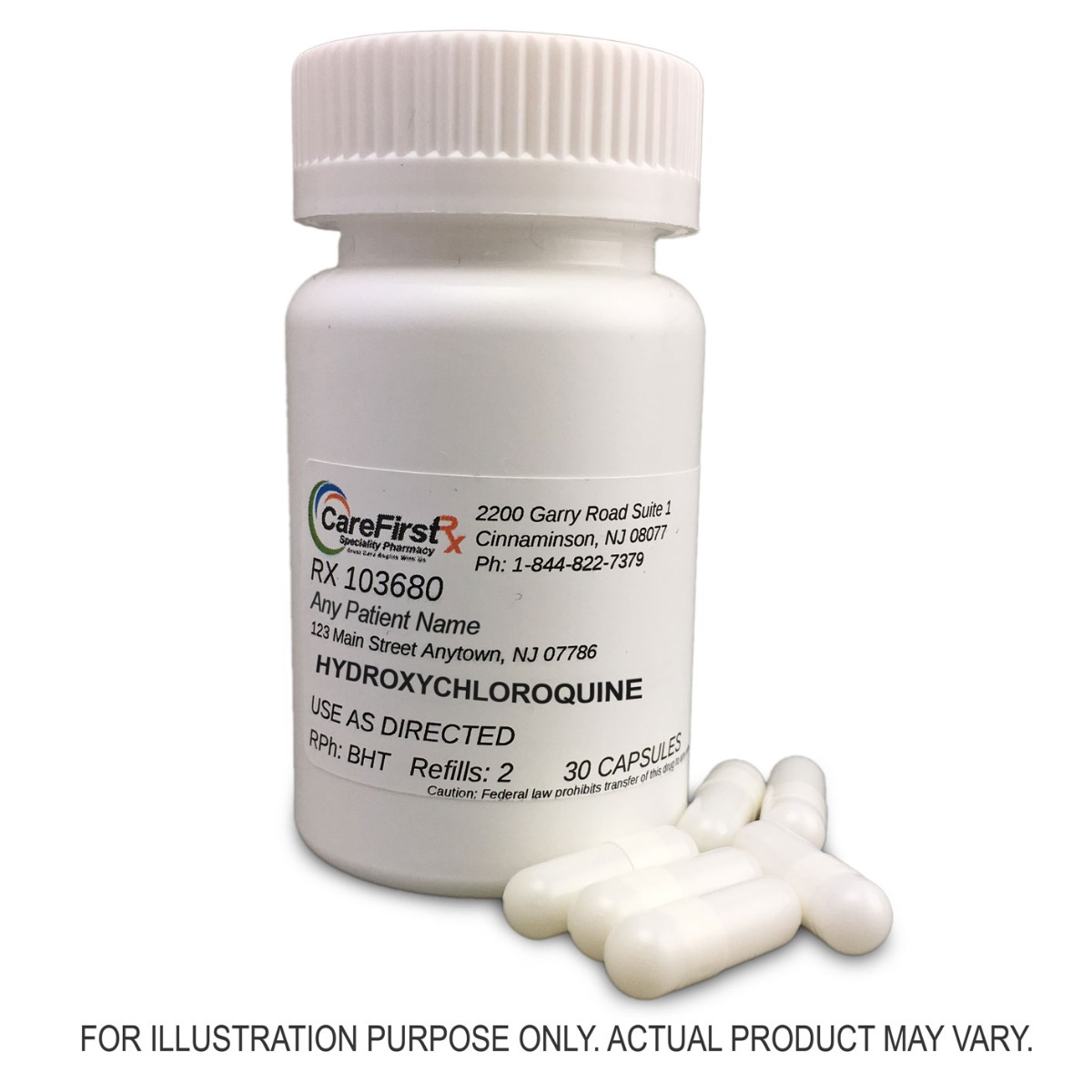
Hydroxychloroquine is an aminoquinoline agent used to treat Lupus, Rheumatoid Arthritis, and Malaria. It acts on multiple immunological pathways including inhibiting viral fusion, assembly and release. While on national shortages, hydroxychloroquine can be made by compounding pharmacies. You may buy Hydroxychloroquine from CareFirst Specialty Pharmacy with a valid prescription from your prescriber.
Start by selecting a form for your price
StrengthSelect a form first
QuantitySelect a strength first
Price: as low as $79.95
Please Note: Due to market volatility, prices are subject to change. Please contact us for the most current pricing.
Ready to Move Forward?
Select the action that best fits how you'd like us to handle the prescription.
This medication requires a prescription.
To process your order we will require a prescription from you or your Prescriber. We will only compound and dispense upon receipt of a valid patient specific prescription.
- Your prescriber can mail or fax in the prescription
- You can mail in the original prescription
- We can contact your prescriber for you
- You can transfer your prescription from another pharmacy

Are you a licensed Prescriber?
Choose the option that best fits how you’d like to send scripts or connect with us.
Fax Your Prescription
Fax (800) 786-1405 or (844) 922-7379 and we’ll process it right away.
Phone In
Call our pharmacists at (844) 822-7379 with prescription details.
Request More Info
Complete the prescriber form and we’ll follow up quickly.
Email Our Team
[email protected] for questions, refills, or status updates.

Looking for a Different Strength?
Pharmacy Info
We are a nationally accredited PCAB compounding pharmacy and a .Pharmacy verified website. A verified .Pharmacy website designation ensures our patients and prescribing partners that our website is verified and safe.
https://safe.pharmacy/buy-safely/?url=cfspharmacy.pharmacy
Drug Description
Actual product image may vary.
Product Info
Hydroxychloroquine is an aminoquinoline/antimalarial agent used to treat Lupus, Rheumatoid Arthritis, and Malaria. It has off-label uses for dermatomyositis, porphyria cutanea tarda, primary Sjögren syndrome, Q fever, sarcoidosis, and most recently, COVID-19. With commercial dosage forms in short supply, compounding pharmacies can make hydroxychloroquine in a strength and dosage form that is appropriate for you.
Pronunciation
hye droks ee KLOR oh kwin
Brand Name
Plaquenil
Drug Class
Aminoquinoline / Antimalarial Agent
🔬 Mechanism of Action
Hydroxychloroquine's mechanism of action is not fully understood, however, it has been shown to increase intracellular pH and inhibit lysosomal activity in immune cells, which is key in reducing T cell activation, differentiation, and expression of costimulatory proteins and cytokines. Furthermore, it alters the pH of endosomes and interrupts binding between toll-like receptors and their RNA/DNA ligand, suppressing TLR signaling. In the cytoplasm, it can interfere with interactions between cytosolic DNA and the nucleic acid sensory cyclic GMP-AMP synthase — cumulatively reducing pro-inflammatory signaling and cytokine production.
📊 Administration & Dosing
- Systemic Lupus / Rheumatoid Arthritis: 200–400 mg daily as a single dose or in 2 divided doses. Do not exceed >5 mg/kg/day using actual body weight.
- Malaria Treatment: 800 mg once, followed by 400 mg at 6, 24, and 48 hours after initial dose.
- Malaria Chemoprophylaxis: 400 mg once weekly on the same day; begin 1–2 weeks before travel and continue for 4 weeks after leaving the malarious area.
⚠️ Drug Interactions
Hydroxychloroquine can interact with many medications. Consult your physician if you are taking artemether, dapsone, lumefantrine, or mefloquine.
📋 Talk to Your Doctor If You Have
Gastrointestinal disorders, hepatic impairment, porphyria, psoriasis, or renal impairment.
🚨 Adverse Effects — Tell Your Doctor If You Experience
• Liver problems (dark urine, abdominal pain, yellow skin/eyes)
• Low blood sugar (dizziness, fatigue, shaking, confusion)
• Vision changes
• Infection
• Bruising or bleeding
• Abnormal eye or body movements
• Seizures
• Mood changes, nightmares, thoughts of suicide
• Hearing loss or ringing in ears
• Tremors or muscle weakness
• Abnormal heartbeat or shortness of breath
• Signs of a significant reaction
🤰 Pregnancy & Breastfeeding
Hydroxychloroquine does not appear to pose significant risk to a fetus at lower doses. The CDC has stated that the malarial prophylactic dose of 400 mg/week is safe. At higher doses for prolonged periods, there is increased fetal risk, though the magnitude is unknown. Daily amounts should be taken cautiously in breastfeeding women because of the slow elimination rate and potential for toxic accumulation in the infant.
📚 References
- Devaux C, et al. International Journal of Antimicrobial Agents. 2020 Mar.
- Centers for Disease Control and Prevention (CDC). Guidelines for treatment of malaria in the United States. Updated April 1, 2019.
- Clarke J. Initial management of discoid lupus and subacute cutaneous lupus. UpToDate. Accessed August 15, 2019.
- Committee on Drugs, American Academy of Pediatrics. The transfer of drugs and other chemicals into human milk. Pediatrics 2001;108:776–89.
- Hydroxychloroquine: from Lexicomp.com. Accessed 4/6/2020.
- Plaquenil (hydroxychloroquine) [prescribing information]. St. Michael, Barbados: Concordia Pharmaceuticals Inc; September 2019.
- Singh JA, et al. 2015 American College of Rheumatology guideline for the treatment of rheumatoid arthritis. Arthritis Rheumatol. 2016;68(1):1–26.
- Zhou D, et al. Journal of Antimicrobial Chemotherapy. 2020 Mar.
Active Ingredients
Hydroxychloroquine Sulfate
Directions
Consult your prescriber.
Instructions
Use the medication as prescribed by your doctor. The information provided is not intended to cover all possible uses. This information is generalized and not intended as specific medical advice. If you have questions about the use of your prescription, please contact your prescriber.
Shipping
Troches and suppositories require refrigeration (ice packs) and will incur an extra charge of $19.95 per order.
Reviews
Customer Reviews
No reviews yet
Leave a Review
We are a nationally accredited PCAB compounding pharmacy and a .Pharmacy verified website. A verified .Pharmacy website designation ensures our patients and prescribing partners that our website is verified and safe.
https://safe.pharmacy/buy-safely/?url=cfspharmacy.pharmacy
Actual product image may vary.
Hydroxychloroquine is an aminoquinoline/antimalarial agent used to treat Lupus, Rheumatoid Arthritis, and Malaria. It has off-label uses for dermatomyositis, porphyria cutanea tarda, primary Sjögren syndrome, Q fever, sarcoidosis, and most recently, COVID-19. With commercial dosage forms in short supply, compounding pharmacies can make hydroxychloroquine in a strength and dosage form that is appropriate for you.
Pronunciation
hye droks ee KLOR oh kwin
Brand Name
Plaquenil
Drug Class
Aminoquinoline / Antimalarial Agent
🔬 Mechanism of Action
Hydroxychloroquine's mechanism of action is not fully understood, however, it has been shown to increase intracellular pH and inhibit lysosomal activity in immune cells, which is key in reducing T cell activation, differentiation, and expression of costimulatory proteins and cytokines. Furthermore, it alters the pH of endosomes and interrupts binding between toll-like receptors and their RNA/DNA ligand, suppressing TLR signaling. In the cytoplasm, it can interfere with interactions between cytosolic DNA and the nucleic acid sensory cyclic GMP-AMP synthase — cumulatively reducing pro-inflammatory signaling and cytokine production.
📊 Administration & Dosing
- Systemic Lupus / Rheumatoid Arthritis: 200–400 mg daily as a single dose or in 2 divided doses. Do not exceed >5 mg/kg/day using actual body weight.
- Malaria Treatment: 800 mg once, followed by 400 mg at 6, 24, and 48 hours after initial dose.
- Malaria Chemoprophylaxis: 400 mg once weekly on the same day; begin 1–2 weeks before travel and continue for 4 weeks after leaving the malarious area.
⚠️ Drug Interactions
Hydroxychloroquine can interact with many medications. Consult your physician if you are taking artemether, dapsone, lumefantrine, or mefloquine.
📋 Talk to Your Doctor If You Have
Gastrointestinal disorders, hepatic impairment, porphyria, psoriasis, or renal impairment.
🚨 Adverse Effects — Tell Your Doctor If You Experience
• Liver problems (dark urine, abdominal pain, yellow skin/eyes)
• Low blood sugar (dizziness, fatigue, shaking, confusion)
• Vision changes
• Infection
• Bruising or bleeding
• Abnormal eye or body movements
• Seizures
• Mood changes, nightmares, thoughts of suicide
• Hearing loss or ringing in ears
• Tremors or muscle weakness
• Abnormal heartbeat or shortness of breath
• Signs of a significant reaction
🤰 Pregnancy & Breastfeeding
Hydroxychloroquine does not appear to pose significant risk to a fetus at lower doses. The CDC has stated that the malarial prophylactic dose of 400 mg/week is safe. At higher doses for prolonged periods, there is increased fetal risk, though the magnitude is unknown. Daily amounts should be taken cautiously in breastfeeding women because of the slow elimination rate and potential for toxic accumulation in the infant.
📚 References
- Devaux C, et al. International Journal of Antimicrobial Agents. 2020 Mar.
- Centers for Disease Control and Prevention (CDC). Guidelines for treatment of malaria in the United States. Updated April 1, 2019.
- Clarke J. Initial management of discoid lupus and subacute cutaneous lupus. UpToDate. Accessed August 15, 2019.
- Committee on Drugs, American Academy of Pediatrics. The transfer of drugs and other chemicals into human milk. Pediatrics 2001;108:776–89.
- Hydroxychloroquine: from Lexicomp.com. Accessed 4/6/2020.
- Plaquenil (hydroxychloroquine) [prescribing information]. St. Michael, Barbados: Concordia Pharmaceuticals Inc; September 2019.
- Singh JA, et al. 2015 American College of Rheumatology guideline for the treatment of rheumatoid arthritis. Arthritis Rheumatol. 2016;68(1):1–26.
- Zhou D, et al. Journal of Antimicrobial Chemotherapy. 2020 Mar.
Hydroxychloroquine Sulfate
Consult your prescriber.
Use the medication as prescribed by your doctor. The information provided is not intended to cover all possible uses. This information is generalized and not intended as specific medical advice. If you have questions about the use of your prescription, please contact your prescriber.
Troches and suppositories require refrigeration (ice packs) and will incur an extra charge of $19.95 per order.
Customer Reviews
No reviews yet